Our Special Guests

SOCIAL EDUCATOR
Ottó Fogarasi
Ottó Fogarasi is a Hungarian social educator based in Turin, Italy. He works - for https://www.playfulintelligence.eu/ - with groups and individuals to help them fully develop their potential, particularly in educational and nonprofit settings, as well as with young people. His work focuses on developing social and life skills such as cooperation and decision-making.
His method is based on experiential learning, creating a challenging but supportive environment. He places strong emphasis on self-reflection and raising awareness - using primarily board games and group games. He is a player himself.
His interventions are usually tailor-made according to the needs of each audience and can range from a few hours to several days. His entire approach is grounded in the values of self-determination, active participation, and voluntary engagement.
Inspired by Johan Huizinga’s idea that play precedes culture and stimulates both our cognitive and emotional capacities, he offers an original approach where instinct and intellect meet.
In Hungarian and English.

Game Designer
Luc Olivier
Luc Olivier holds a Master's degree in Geography from CESA at the University of Tours. He served in the French Army as a second lieutenant and section leader. With extensive experience in IT consulting, he is currently the CEO of a Franco-Hungarian IT services company. He has designed around twenty commercial wargames, including two on Dien Bien Phu, published in magazines such as Vae Victis and Battles Magazine. He has also written and published numerous articles on historical military topics over the past twenty-five years, including a definitive work on the Battle of Dien Bien Phu.
He will present his new co-creation, "Budapest 1956: Those of Corvin," to be published in Vae Victis magazine issue #189.
In French and English.

Writer
Dávid Dorosz
When the Past Doesn’t Stay in the Past: A Thriller at the Heart of the Secrets of 1989
What if the fall of communism in Hungary did not reveal the whole truth?
With his new novel, which he will present, Hatalom árvái (forthcoming in English translation), Dávid Dorosz takes us into a gripping investigation where the present begins to crack under the weight of the past.
It all starts with a disappearance: a teenage boy vanishes without a trace in what appears to be a quiet Hungarian town. But the investigation quickly spirals out of control. What seemed like a simple case turns into a vertiginous descent into the shadowy corners of recent history.
Because behind this disappearance lies a secret buried since 1989. That year, Hungary turned the page on communism. Officially, the transition was peaceful. But in the shadows, some stories were never told. Decisions were made, alliances forged, truths buried.
And today, they are resurfacing.
Through a tense and deeply human narrative, Dávid Dorosz explores a simple yet unsettling question: what really remains of a regime once it disappears?
His novel reveals how the past continues to haunt the present:
in networks of power
in collective silences
in individual destinies
Accessible, compelling, and at times brutal, Hatalom árvái is more than a thriller. It is a story about memory, about what we choose to forget — and what inevitably comes back.
In English and Hungarian.

Jack of All Trades
Frédéric Poncelet
A former soldier, now working as an investigator on international humanitarian law, Frédéric Poncelet draws on his extensive field experience, which informs his thinking and fuels a constantly evolving curiosity.
His diverse professional background, encompassing studies in journalism, international business, and political science, has provided him with a multifaceted perspective, both analytical and open to international issues.
Particularly interested in power dynamics and conflicts, as well as major geopolitical shifts, he places great importance on questions of perception, representation, and emotion within these contexts.
Half-Belgian and half-Hungarian through his mother, he experienced the end of the Cold War and both sides of the Iron Curtain as a child, carrying within him a powerful family memory that lends a unique resonance to his work. At the crossroads of lived experience and analysis, he offers an accessible and insightful perspective. Skilled at communicating and making complex topics accessible, he knows how to captivate his audience. His intervention will establish bridges between history, strategy and the world of gaming (because he also happens to be a gamer!), thus offering an original and stimulating reading of the past.
In Hungarian, French and English.

Collector
Denis Muzsnay
Denis Muzsnay grew up in the Somme region of France, amidst landscapes scarred by the battlefields of the First World War, an environment that profoundly nurtured his interest in this period.
Of Hungarian origin, he is the son of a refugee who fled Hungary in 1956.
A physics and chemistry teacher at the French high school in Budapest since 2002, he combines scientific rigor with a passion for history. Over the years, he has specialized in the study of trench art, and more specifically, the lighters made by soldiers, which he collects.
Through these everyday objects transformed into unique works of art, he offers a fresh perspective on the lives of the combatants, exploring their ingenuity, survival skills, and personal and artistic expression.

Youtubeur
Quentin Censier
« Sur le Champ »
Creator of the YouTube channel "Sur le Champ" (143k subscribers • 130 videos), Quentin Censier has established himself as a leading figure in online military history. A former robotics engineer and graduate of École Polytechnique (X), he has been developing an original approach since 2016, blending historical rigor, tactical analysis, and accessible teaching methods.
Through videos covering everything from ancient battles and conflicts to the First World War, he analyzes military mechanisms, strategic choices, and the human realities of war, far removed from simplistic or heroic visions.
His work places significant emphasis on critical thinking, the history of military ideas, and understanding the political and social context of conflicts.
Passionate about wargaming and tactical reenactment, Quentin Censier also explores how games can become tools for historical understanding. Several of his shows and collaborations directly address the link between military history and strategic simulation, a topic central to his participation in our Convention. With its accessible tone, humor and documentary rigor, it has contributed for several years to renewing the dissemination of military history to a wide.
French-speaking audience.


Michel Salzmann
Michel Salzmann, a Swiss-Portuguese painter living in Budapest
Historian – Deputy Scientific Director of the Otto von Habsburg Foundation
Wargamer – Historical Tabletop Creator
Sebestyén László
Michel Salzmann is a Swiss-Portuguese painter, born in Lisbon in 1971.
He graduated with a diploma in visual arts from the Collège de Saussure in Geneva in 1991. His teachers included Marc Jurt, Ilie Pavel, and Jean Stern. He also completed internships in Gilbert Mazliah's studio in Geneva. After a career in institutional and private finance, as well as philanthropy, he has devoted himself entirely to painting since 2022.
His creations explore timeless and universal themes through figurative and semi-figurative works. They recurrently address the interaction or fusion between beings within defined environments. His work draws on both classical traditions and contemporary visual culture to create paintings that question perception and invite contemplation, provoking a dialogue between intention and instinct. He frequently uses acrylics and charcoal on various supports such as canvas or paper.
His studios are located in Budapest (a city with which he has a special connection), Geneva, and Sintra.
In English.
Gergely Fejérdy
Topic: Otto von Habsburg and the 1956 Hungarian Revolution
A specialist in international relations and the history of 20th-century Central Europe, Gergely Fejérdy holds a PhD from the Paris-Sorbonne University. He teaches at Pázmány Péter Catholic University and also served as a diplomat in Paris between 2015 and 2019. Since 2020, he has been Deputy Scientific Director of the Otto von Habsburg Foundation.
In this lecture, he will explore the role played by Otto von Habsburg in the context of the Hungarian Revolution of 1956. By highlighting the international dimensions of the event, he will examine the networks of influence, diplomatic challenges, and political hopes that shaped this pivotal moment of the Cold War.
In french.
Sebestyén László is a passionate historical wargamer, recognized for the immersive quality of his tabletop creations, which have received multiple awards at events such as Historikum and Wargamecon.
His work stands out for its strong visual impact and careful attention to atmosphere.
Drawing on photographs, eyewitness accounts, and historical research, he designs environments that aim not to perfectly replicate reality, but to create a credible and evocative experience. His approach focuses on immersion and accessibility, allowing audiences to better understand complex historical historical situations through gameplay.
In english and hungarian.


Photographer
Michel Levaï
WRITER – LITERATURE TEACHER
Passionnate about history
Forró Gergö
A literature teacher and writer, Michel Levaï is the author of The Revolution, My Father and Us – Budapest, 1956, published by L’Harmattan in 2022, as well as Who Killed My Mother.
Through his writing, he explores the links between personal history, family memory and major historical events. His latest book tells the story of his father, Alexandre, a young Hungarian who took part in the 1956 Revolution, and examines how this history was passed down through generations.
At the Convention, Michel Levaï will talk about his book, his work as a writer, and more broadly about his connection to Hungary, 1956 and the transmission of memory.
In french and hungarian
Sándor Szabó is a respected Hungarian professional in finance and business development, with an international career spanning more than twenty-five years. Beyond his professional experience, he is deeply passionate about Hungarian history and the memory of his country.
Having grown up in a village near Szolnok, he has developed a deeply personal connection with Hungary’s history and traditions. This background informs his perspective and gives his talk a dimension that is at once scholarly, intimate, and rooted in lived experience.
In english and hungarian.
Forró Gergö is a photographer who explores the image as a territory for research and contemplation.
In english and hungarian.
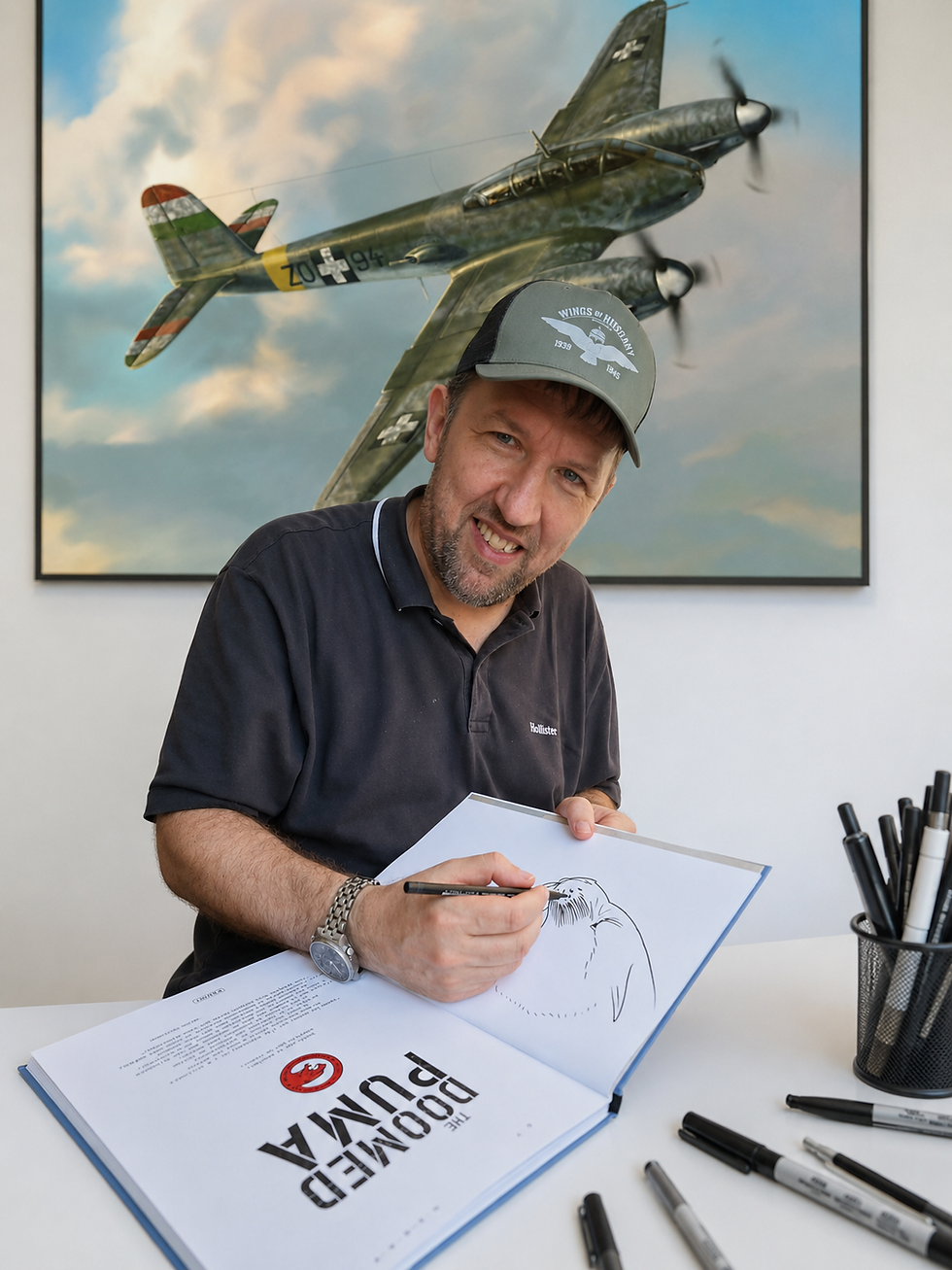
Hungarian artist, illustrator, graphic designer and comic-book author
Gyula Pozsgayi
Gyula Pozsgay is a Hungarian artist, illustrator, graphic designer and comic-book author, born in Tatabánya in 1973.
Trained in architecture and economics, he began working as a graphic designer and game developer while still at university.
His work spans illustration, graphic design, comics, painting and photography.
He is particularly known for his work on video and board games, book covers, military history and aviation.
His passion for drawing was partly inspired by his grandfather, a former gunner and amateur pilot during the Second World War, "The Old Tiger".
His comics have been published internationally, including in Hungary, France and the Netherlands, by publishers such as Képes Krónikák Kiadó, Éditions Paquet and Dark Dragon Books.
In english and hungarian

Games designer
Alfa Diallo
Energy economist by day, game designer by night: Alfa Diallo loves games that make you think — but above all, adapt, bluff and interact with your opponents.
His games are designed for experienced players, with a strong focus on tactics, direct player interaction and unexpected twists, rather than the more traditional eurogame approach where everyone quietly builds their own strategy.
At the Convention, Alfa will showcase his two most advanced projects: Influence is Power, where provincial leaders compete for the crown, and Mafia Control, a ruthless struggle between rival gang leaders for control of the territory.
Prototypes, fresh ideas — and a glimpse at the games of tomorrow!
In english and hungarian